The owner of Ecological Land Management and Stewardship, Colby Fong, was formerly the Conservation Lands Manager for New Hampshire Audubon, a non-profit organization. New Hampshire Audubon contributes to protecting the environment for wildlife and people across the state of New Hampshire.
Colby has stayed connected to New Hampshire Audubon after leaving their staff, to start Ecological Land Management and Stewardship LLC. Colby still volunteers with NH Audubon as a sanctuary steward. During Colby’s time at New Hampshire Audubon, it was of interest to him to see climate resilient tree plantings occurring after forest management activities.
The context:
The Popple Island Wildlife Sanctuary is in Epsom, New Hampshire. The sanctuary has significant shoreline along Odiorne Pond which is a valuable wildlife resource.
In 2020, New Hampshire Audubon completed a forest management harvest, in unhealthy and stagnating eastern white pine that were affected by white pine weevil. One of the objectives was to regenerate a forest more suited to the site. This redistribution of light to the forest floor led to the natural regeneration of species like quaking aspen, a younger cohort of eastern white pine, American beech, and northern red oak.
These regenerating species will all contribute to the next stand. However, American beech is facing some threats in the region. American beech currently faces the dual threats of beech leaf disease and beech bark disease. Beech leaf disease is caused by a foliar nematode which infects the leaves of American beech creating a banding in beech leaves. Beech leaf disease can be fatal to American beech, and it is still not yet known how much mortality of American beech will occur across the landscape. However, it is clear that in some places, it causes complete mortality of all American beech. Beech bark disease is a disease complex caused by a scale insect and followed by a fungal infection. Beech bark disease reduces the vigor of American beech and can cause mortality.
Nonetheless, the forest management activity created conditions for a more diverse and well suited stand of trees at the Popple Island Wildlife Sanctuary. Forest management created the conditions for young trees to thrive. The young stands of quaking aspen will provide preferred cover and forage for species like Ruffed grouse and American woodcock. Young aspen stands are a preferred habitat for many early successional shrubland utilizing species as well as a preferred browse for white-tailed deer.
Northern red oak will be well suited to the warming climate in New Hampshire and will eventually carry on the legacy of producing mast that will be consumed by wildlife species like wild turkey, white-tailed deer, squirrels, blue jays, mice, black bears and raccoons.
While Colby was still the Conservation Lands Manager for NH Audubon, he and a local volunteer, Dave Nelson, sanctuary steward of the Popple Island Wildlife Sanctuary started to create a plan for planting other species into the open conditions created in 2020.
They initially planned to plant white oak. White oak is a tree that produces a calorie dense acorn with much less tannin than northern red oak acorns. This lack of tannin makes them a much more prized food source by wildlife. White oak is also well suited to our warming climate. Finally, planting white oak would have been a form of restoration; as white oak was over harvested on the New Hampshire landscape through the 1800s an 1900s. This was due to the wood of white oak being water resistant, beautiful, strong, and rot resistant. These qualities made white oak an excellent choice for boat building, use in houses and barns as timbers, and as staves for barrels. Its great values led to people harvesting white oak at higher rates than other trees.
For all these reasons, Colby and Sanctuary Steward Dave Nelson, wanted to plant white oak. However, when spring rolled around the New Hampshire State Nursery had sold out of white oak when Dave attempted to put in their order. However, Dave Nelson continued to look to different options and noticed that the State Nursery still had Black Walnut. Dave put in his order and donated the seedlings to NH Audubon.
Epsom, is on the northern edge of black walnut’s range. Black walnut will hopefully be a climate resilient tree into the future, and black walnut also produces hard mast forage that is particularly beloved by squirrels. In addition to being a preferred mast for certain species black walnut is utilized by many insect species as a host tree. The leaves and sap are fed upon by many insects including luna moths in their larval stage. The presence of many insects brings insectivorous birds which feed upon the ample food source. Over 100 insects use black walnut as a food source and dozens of bird species feed on the insects that utilize black walnut.
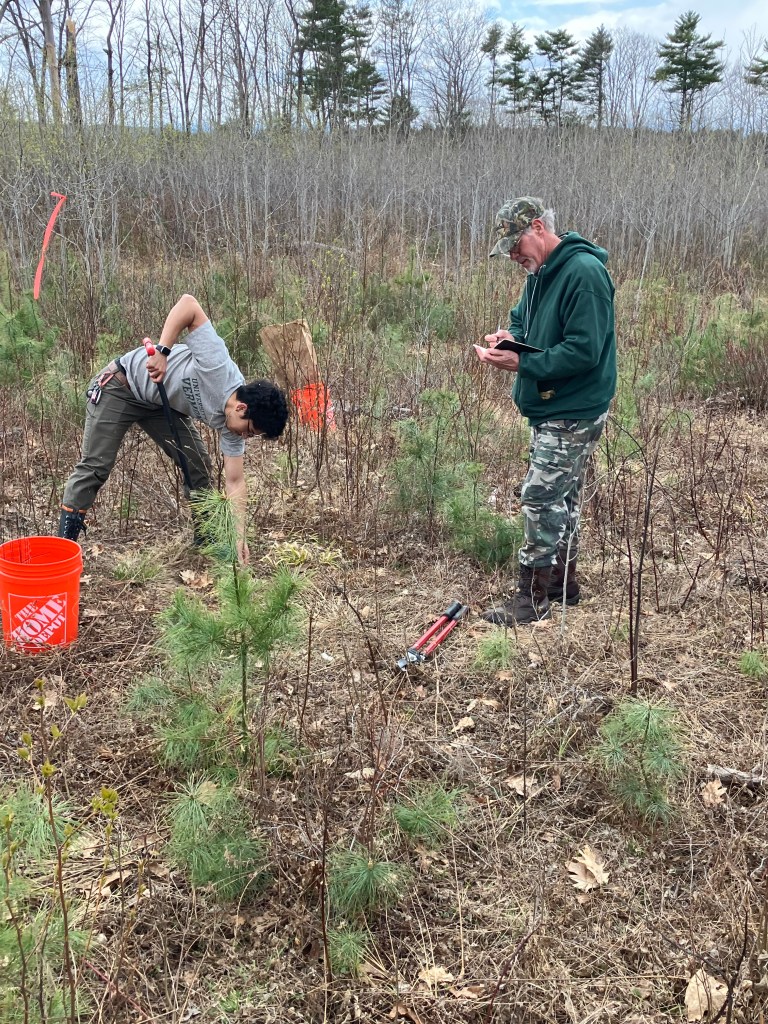
Dave then reached out to Colby and together they planted the black walnuts based on a grid that Colby laid out. They favored the best microsite over strict spacing. A GPS point was collected for each black walnut seedling so the seedlings can be monitored as they grow and re-identified for clearing competing vegetation.
If you would like to do a climate resiliency planting or wildlife tree planting on your property reach out to us and Ecological Land Management and Stewardship LLC would be happy to help you select a species that is well suited to your goals and land. As well as create a planting plan covering all the details like, which aspects are best for a given species, what soils types are present on your property, browse protection, spacing, and much more.

 Ecological Land Management and Stewardship